· bmux guides
Better Browser Bookmarks: Search, Folders, and Editable URL Parameters
Save and search profile bookmarks, edit URL parameters, and manage readable YAML files in bmux. Includes a practical walkthrough.
Walkthrough transcript
Save a search with Command+D. Find the saved page by title. Change its limit query parameter to 40. Open the customized bookmark in a new tab.
Introduction
A useful bookmark can be more than a link you save once and forget. In bmux, you can search it by title, folder, or URL, open it in a new tab, and adjust its URL parameters before opening it.
The September 16–18 additions brought a bookmark editor, searchable folders, YAML storage, improved result ranking, and parameter controls. Together they work well for recurring searches and dashboards where the destination stays the same but a filter changes.
The Tart walkthrough above saves a local search page, finds it again, changes its result limit, and opens the customized URL. The fixture demonstrates the browser controls without depending on a live service.
Bookmarks, history, and saved layouts solve different problems
| Tool | Keep it for | How you return |
|---|---|---|
| Bookmark | A page or search you intend to reuse | Search its title, folder, or URL |
| Browsing history | A page you visited but did not save | Search the current profile's history |
| Saved layout | A workspace arrangement | Restore the named layout, with confirmation |
Bookmarks are scoped to profiles. This is helpful when the same service has separate work and personal logins. A bookmark belongs to the profile where you saved it; its destination opens with that profile's browsing identity.
The underlying idea is familiar: Chrome's bookmark guide describes saving and organizing pages. bmux adds a transient searchable picker and editable query controls to that everyday workflow.
Save a page into a useful folder
Press Command+D or run bookmark from the command prompt. Give the page a recognizable title and choose a folder. From a folder row, / starts folder search. Use Up/Down and Enter to choose a result, or create a folder inside the selected folder.
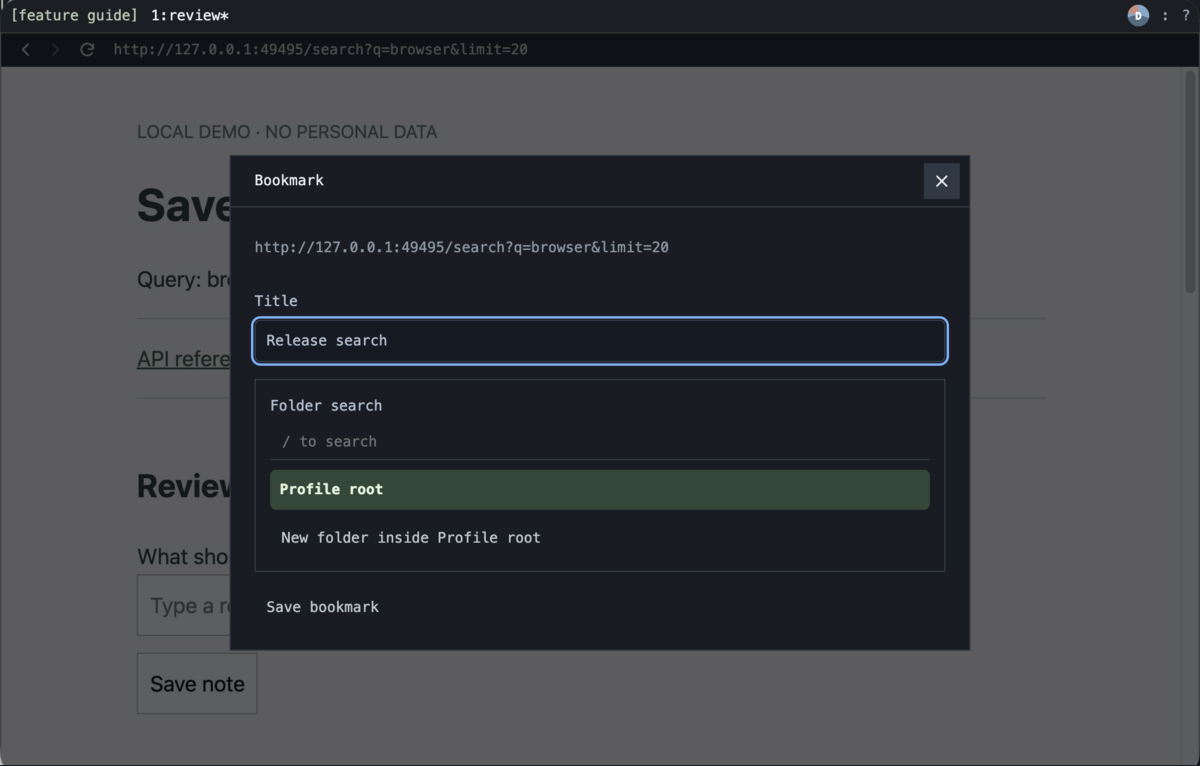 Native bookmark editor captured in Tart. The saved URL belongs to the local demonstration server.
Prefer a title that explains the task: “Release search” is easier to find than a title inherited from a generic search-results page. Keep the folder hierarchy shallow enough that a folder name gives useful context in search results.
Search and open without replacing your page
Run bookmarks, type a query, use the arrow keys to choose a result, and press Enter. bmux ranks title matches ahead of folder and URL matches. Searching a hostname can still find a page when you cannot remember its title.
Opening a bookmark creates a new tab in the selected pane. The original page remains in that pane's tab list. This is different from creating a split or another internal window: it preserves the current layout while opening another page within it.
The picker remembers searches per profile during the running UI session. Treat that as a convenience, not a substitute for a clear bookmark title or a promise of cross-device synchronization.
Turn query parameters into reusable controls
If a saved URL has query parameters, its sliders button opens controls beside the bookmark. Text values get text inputs; numeric values also get sliders. The local example uses q=browser&limit=20. Changing limit to 40 changes the URL used for the next open.
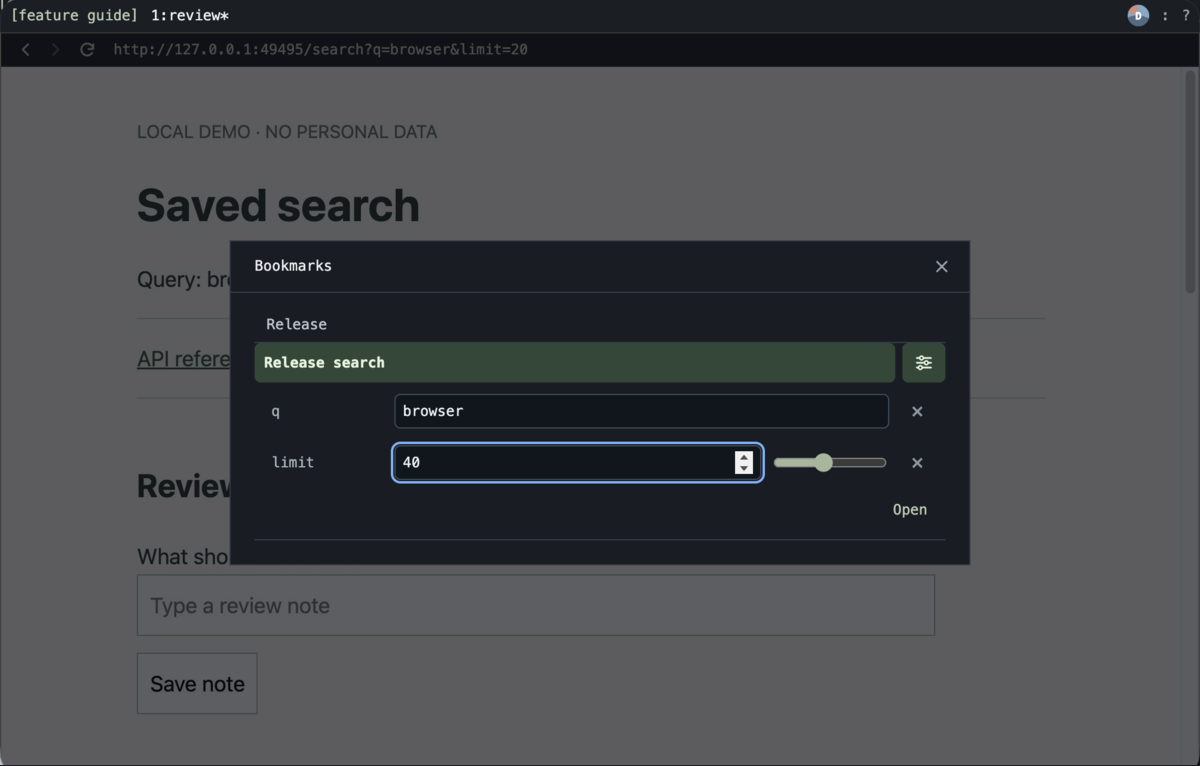 Real bmux parameter controls in Tart. The local page accepts a demonstration query and result limit.
This is useful for dashboards with an existing URL filter, searches with a query string, or pages with a numeric result limit. It does not add a filter that the destination website does not support. The browser edits the URL; the site decides what that URL means.
The remove button omits a parameter from future opens and hides its control. Custom values and hidden parameters are stored separately from the original saved URL.
For X search bookmarks, bmux also exposes numeric min_faves and min_replies operators inside q. It does not offer a minimum-view-count operator. Site search behavior can change, so check the resulting search on the site rather than treating a saved URL as a guaranteed query API.
Keep bookmarks in readable YAML
bmux stores bookmarks beside the keyboard configuration, normally at ~/.config/bmux/bookmarks.yaml. Each profile has its own list. A folder contains children; a page has a url.
profiles: profile_default: - id: research title: Research children: - id: release-search title: Release search url: https://example.com/search?q=browser&limit=20This is an illustrative URL and minimal file shape. Preserve the profile IDs and unique bookmark IDs already present in your file when editing real data. Parameter overrides live in bookmark-parameters.yaml.
Edit bookmark YAML while bmux is closed, then restart to load it. Unlike keyboard settings, manual bookmark-file edits do not reload live. An invalid bookmark file prevents startup so the application does not overwrite the invalid edits. See the bookmark file reference for configuration-path overrides.
Bookmarks FAQ
Can I import my existing folders?
bmux can import Brave profile names and bookmarks. See Import from Brave. Imported folder structure is preserved; this is an import, not continuous synchronization.
Why is a bookmark missing in another pane?
Check the pane's profile. Bookmark search is profile-scoped. A second pane with the same profile sees the same bookmarks; another profile has its own list.
Can a bookmark change POST form fields or application state?
These controls customize URL parameters. They do not edit request bodies or arbitrary state kept inside the page. Start with a destination that already encodes the filter you need in its URL.
Should I save every visited page?
Use bookmarks for destinations you expect to reuse. Use history for pages you need to find after the fact. For a recurring search, save one clear bookmark and adjust its supported parameters instead of keeping many near-duplicate URLs.